Brush Clearing That Gives You the Property Back
When Hand Tools and Normal Mowing Are No Longer Enough
Brush does not take over a property overnight.
A few saplings appear along a field edge. Alder, willow, volunteer hardwoods or other woody growth starts filling the open space. A trail gets a little narrower every year. The edge of the yard moves closer to the house. What was once an easy area to maintain becomes too thick for a lawn mower and too large to attack efficiently with hand tools.
That is when mechanical brush clearing starts to make sense.
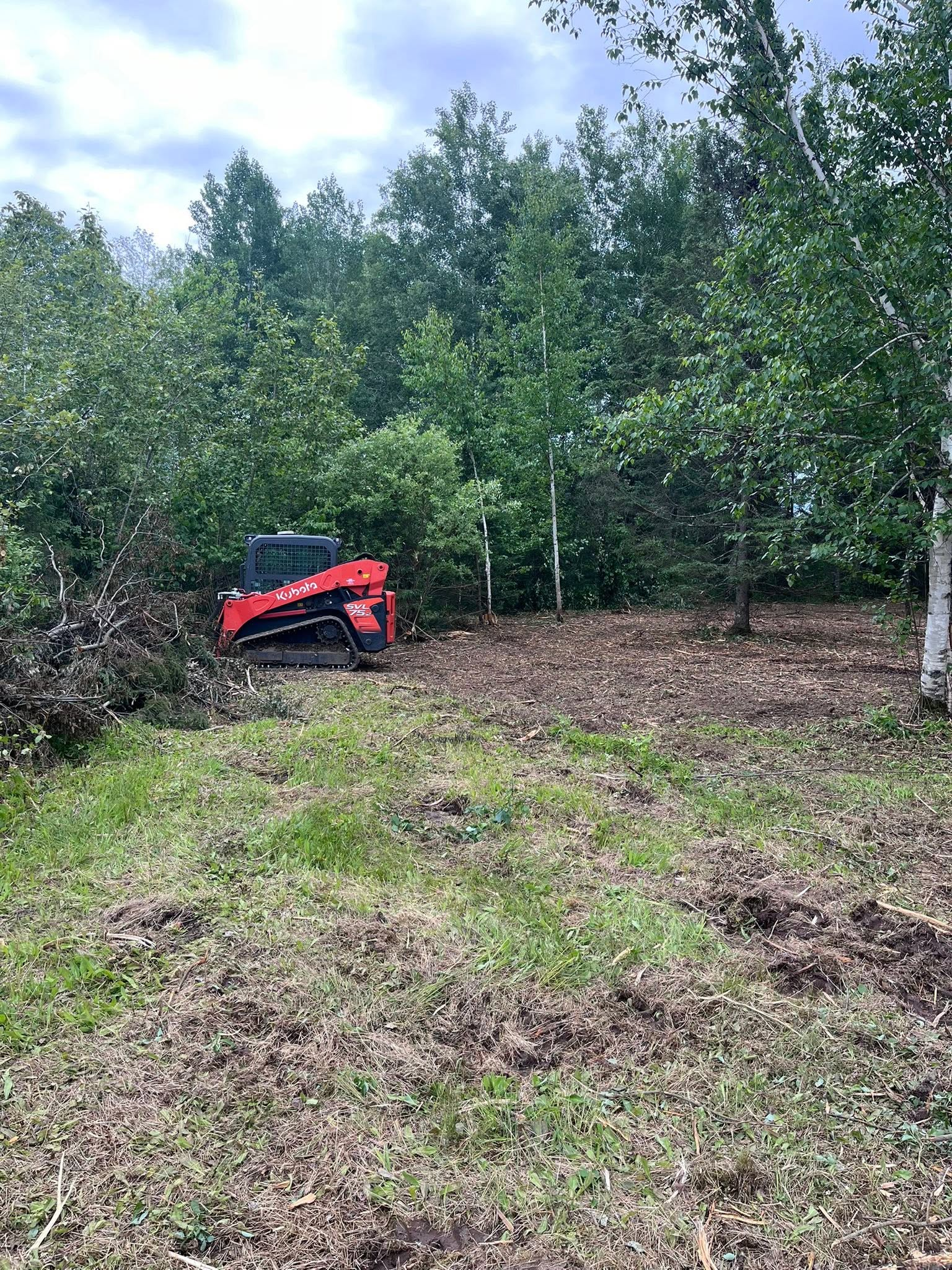
First Cut Landworks uses skid-steer equipment to cut, reduce and manage dense brush, saplings and overgrown vegetation so the area can become usable again.
The goal is not to sell “clearing” as a vague service. The goal is to solve a specific property problem: visibility, access, maintenance, hunting use, defensible space, a cleaner property edge or simply getting an overgrown area back under control.
Brush Mowing Versus Forestry Mulching
These methods overlap, but they are not identical.
A heavy brush mower is a strong tool for knocking down dense growth, cutting saplings and reclaiming larger areas efficiently. It is often the best answer when the job is primarily heavy vegetation mowing and the customer does not need every piece of material finely processed.
Forestry mulching uses a specialized head to grind and process woody vegetation more aggressively. It can be a better fit in dense understory, selected trail corridors, tighter wooded areas or projects where reducing loose woody material in place is important.
One method is not automatically “better.” The right choice depends on the property.
A site can also use both methods. For example, open brush may be mowed while a dense wooded edge is mulched.
What I Clear
Brush-clearing projects can include:
- Dense bush and woody understory
- Saplings and volunteer growth
- Field edges that have grown inward
- Overgrown fence lines
- Brush around trails and access routes
- Vegetation blocking driveway sight lines
- Old yard areas that have reverted to brush
- Hunting-property openings and access
- Brush around structures where additional separation is wanted
- Manageable deadfall mixed into an overgrown area
- Invasive woody brush as part of a longer-term management plan
The exact equipment depends on density, stem size, ground conditions and what you want the area to look like afterward.
What to expect after the first cut
Mechanical brush clearing resets heavy overgrowth by cutting and reducing the vegetation above ground so the area becomes usable and maintainable again.
Many woody species can resprout after being cut. Invasive species can also return from seed already present in the soil or from new seed brought in by wildlife.
What happens next depends on the species and how you want to maintain the area. Some properties can be kept open with routine mowing; aggressive woody or invasive growth may need periodic follow-up.
What mechanical clearing does extremely well is knock back dense growth, reopen space, reduce heavy woody material and put the property back into a condition where the owner can manage what happens next.
For many properties, getting from “I cannot even walk through it” to “I can mow, monitor or selectively maintain this area now” is the biggest step.
Selective clearing around trees you want to keep
A lot of customers do not want a blank field. They want the junk cleaned out while preserving the better trees.
Selective clearing can remove brush and small growth from around established trees, open sight lines and make the woods easier to move through while leaving the larger trees that contribute shade, appearance, screening or habitat.
How close equipment can work to a specific tree depends on trunk location, root exposure, terrain, rocks and the surrounding vegetation. I do not promise a fixed distance or claim that machine work has zero impact on soil and roots. I make practical decisions based on what is actually on the site.
overgrown fields and property edges
Field edges are some of the fastest areas to lose.
Once woody growth gets established beyond what a normal mower can handle, the open area shrinks year after year. Mechanical brush mowing can push that edge back and restore the area to a point where routine mowing becomes realistic again.
The same idea applies to old lawns, open lots and unused corners of a property. Reclaiming the space once with heavier equipment can make future maintenance much easier.
fence lines and boundaries
Brush growing through a fence line creates problems beyond appearance.
It can make the fence hard to inspect, restrict access, hide damaged sections and turn future repair into a much larger job.
I can clear brush along fence lines when access allows. Property lines themselves need to be known and marked by the owner when there is any uncertainty. Brush clearing is not surveying, and I do not guess where a legal boundary sits.
Driveway sight lines and access
A driveway can become harder to use when brush closes in around curves, gates or road approaches.
Selective clearing can push vegetation back, improve visibility and create more usable clearance for trucks, trailers and equipment.
This type of work is often small in acreage but high in practical value because it affects the part of the property you use every day.
Invasive Brush: Start With the Heavy Work
Dense buckthorn and other invasive woody plants can absolutely be cut or mulched mechanically, especially when the infestation is too large to deal with one plant at a time.
The first goal is to knock the infestation back, restore access and make the property manageable enough for whatever follow-up strategy makes sense.
Species such as buckthorn can resprout from cut stems or return from seed, so long-term control can involve follow-up cutting, pulling or targeted treatment after the initial mechanical clearing pass.
I would rather explain that upfront than promise that one day with a machine permanently solves a biological problem.
When is a Good time to clear brush?
There is no single perfect season for every property.
Fall is often an excellent time because leaf drop improves visibility, cooler weather makes work more comfortable, and the finished area is easier to evaluate before the next growing season. Depending on the site, frozen ground can also improve access later in the year.
Spring and summer can work well too when ground conditions are firm enough for equipment.
Wet ground, saturated soils and hidden obstacles can change what is practical, so timing should be based on the property rather than a calendar slogan.
what affects project cost?
The biggest factors are density, stem size, acreage, access and obstacles.
A lightly overgrown acre is a very different job from an acre packed with woody stems, rocks, old wire, stumps and fallen material.
Selective work can also take longer than simply mowing everything because the equipment must work carefully around trees or features that stay.
Other factors include slopes, wet areas, travel, material handling and the finish you want.
I price the project around the actual conditions instead of pretending every acre carries the same production rate.
Frequently Asked Questions
Do you remove large trees?
First Cut is not a tree service. My normal scope focuses on brush, saplings, small woody growth, understory, deadfall and vegetation-management work that fits skid-steer equipment. Large tree felling and hazardous standing trees should be handled by a qualified tree contractor.
Will the brush grow back?
Some of it can. Mechanical cutting does not sterilize the ground or remove every root system. The amount of regrowth depends on species, season, site conditions and what follow-up maintenance is done.
Can you pile material instead of mulching it?
Depending on the project, yes. Material may be mowed, mulched, grappled and piled, or handled with a combination of methods. The best approach depends on volume and what you want the finished site to look like.
Can you clear around mature trees?
Yes, selective understory clearing is possible when equipment access and the layout allow it. The exact approach depends on the individual site.
Can brush clearing help me maintain the area myself afterward?
That is one of the best reasons to do it. Heavy equipment can knock the property back from an unmanageable condition to a level where normal mowing, trimming or periodic maintenance becomes realistic again.
Manage What You Can Control
The value is in taking control of the vegetation and access conditions you can actually change.
You can control whether brush is packed against the maintained area, whether deadfall is allowed to build indefinitely and whether your access routes stay open.
If those areas have gotten ahead of you, send photos and a description of the property.
I can help turn the mechanical clearing portion into a practical scope.
Cut Hard. Finish Clean.