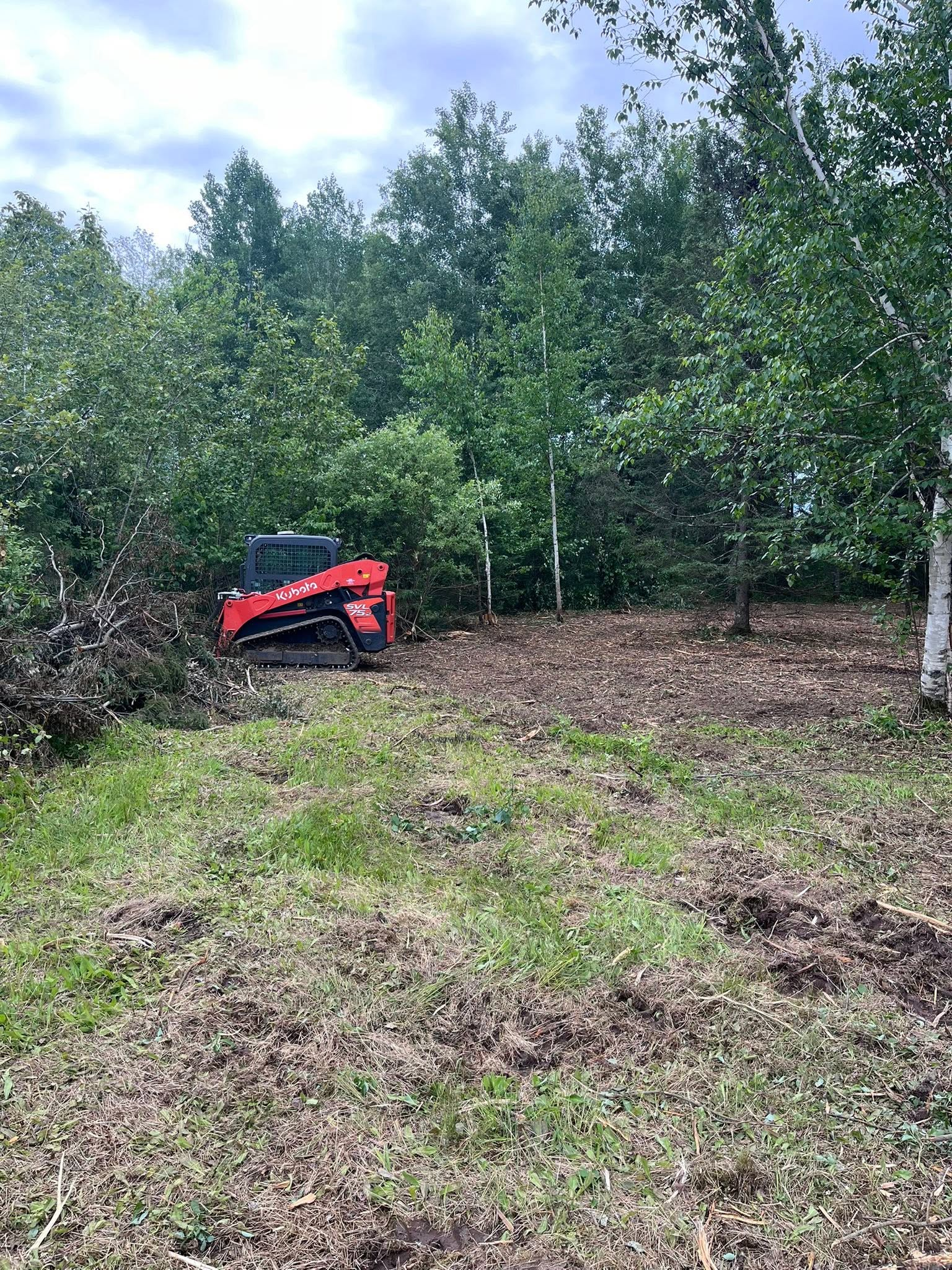
Create More Defensible Space Around the Places That Matter
Fire Mitigation Starts With Vegetation You Can Actually Manage
A wooded property can look healthy and still have a lot of unnecessary fuel near a home, cabin or outbuilding.
Deadfall accumulates. Brush fills the understory. Young trees crowd together. Tall vegetation grows against structures. Access routes narrow. Ground-level and mid-level vegetation can create continuous paths through areas that have not been actively managed for years.
First Cut Landworks provides mechanical vegetation reduction and defensible-space clearing to help property owners get those conditions under better control.
The work is practical fuel reduction and access improvement: less unmanaged brush and deadfall, more separation, and better access to the areas that matter.
What Defensible Space Means
Defensible space is the managed area around a structure where vegetation and combustible material are intentionally reduced.
Firewise guidance commonly breaks the area around a structure into zones, starting with the immediate area closest to the building, then extending outward into landscaped and wooded portions of the property.
The exact work a skid steer should perform depends on the property. The closest area to a house may require hand work, landscaping changes or noncombustible materials that are not part of my service.
My role is the mechanical side: dense brush reduction, selected deadfall cleanup, understory management and opening access where larger equipment is appropriate.
Mechanical Fuel reduction
Mechanical fuel reduction can address:
- Dense brush
- Young woody growth
- Selected deadfall
- Overgrown edges near structures
- Continuous understory between woods and maintained areas
- Overgrown access routes
- Brush around outbuildings
- Vegetation that makes inspection and maintenance difficult
The goal is to break up unnecessary vegetation and leave the property easier to maintain.
Deadfall and Downed Material
Deadfall is one of the most obvious things property owners notice because it accumulates slowly until the woods are full of it.
Where material is manageable with my equipment, I can move, consolidate, mow or mulch selected debris as part of the clearing plan.
First Cut focuses on the brush, understory, selected deadfall and access work that skid-steer equipment is suited for. Large hazardous standing trees can be handled by a qualified tree contractor when needed.
If a tree is dangerous, leaning over a structure or requires specialized rigging, that belongs with a qualified tree contractor.
Dense Understory and Ladder Fuels
Brush and small woody growth can fill the space between ground vegetation and larger trees.
Reducing that understory can create more separation, improve visibility and make ongoing maintenance more realistic.
Selective work is often better than removing everything. Established trees can remain while brush, saplings and cluttered growth are reduced around them.
The desired finish should match the property. A cabin in the woods does not need to look like a parking lot to be better managed.
Forestry Mulching as Part of Fuel Reduction
Forestry mulching can be useful on dense understory because it processes woody vegetation in place.
That can reduce the amount of loose brush that otherwise needs to be piled.
Mulched wood is still organic and combustible material, so I do not claim that mulching “removes all fuel.” The benefit is reducing standing and connected vegetation, processing woody growth and making the area easier to access and maintain.
That is a more accurate description of what the machine actually does.
Driveway and Emergency Access
Defensible space is not only about the area directly next to the building.
An overgrown driveway or access lane can make it harder for the owner, maintenance equipment or emergency vehicles to reach the property.
Brush clearing along driveways, gate areas, turnarounds and access routes can improve visibility and physical clearance.
I do not certify emergency-vehicle access or road standards. I can clear vegetation to the width and area the property owner identifies.
Cabins and Seasonal Properties
Seasonal properties can accumulate vegetation quickly because no one is there every day to notice the gradual change.
A cabin that felt open five years ago may now have brush against the yard, deadfall along the access route and young trees filling the space between the structure and mature woods.
Mechanical clearing can reset those areas and make annual maintenance far more practical.
This can be combined with trail work, shooting-lane clearing, storm cleanup and other property-management work during the same project.
The Goal: More Defensible Space, Less Unmanaged Fuel
No contractor should promise that brush clearing will stop a wildfire.
Weather, wind, fuel moisture, structure materials, ember exposure, topography and the conditions on surrounding property all matter.
Vegetation management is one piece of a broader risk-reduction strategy.
You cannot control every wildfire condition, but you can control a lot of what is happening on your own property. Dense brush, deadfall and continuous vegetation are practical places to start.
When to Do the Work
Fuel-reduction work can be done whenever ground and site conditions allow safe equipment access.
Fall can be especially practical because vegetation is easier to see after leaf drop and cooler weather can make woods work more efficient.
Frozen ground can also help on selected properties where soft conditions limit access during warmer months.
The best timing depends on the site.
Frequently Asked Questions
Do you perform a certified wildfire assessment?
No. I provide mechanical vegetation and deadfall reduction. Property owners who need a formal wildfire risk assessment should use the appropriate Firewise or fire-management resources.
How far from the house should I clear?
There is no single distance that replaces site-specific guidance. Firewise programs use multiple zones around structures. I can perform the mechanical clearing portion where it fits the property and equipment access.
Do you remove large dead trees?
Large hazardous standing trees are tree-service work. I focus on brush, small woody growth, understory and manageable downed material.
Is forestry mulching good for defensible space?
It can be a useful mechanical method for reducing dense woody understory, opening access and turning an unmanaged area into something that is easier to maintain as part of a broader defensible-space plan.
Can you clear around a hunting cabin and also reopen trails?
Yes. Combining related work can make sense because the same mobilization can address the structure area, access and trail system.
Get the Area Back Under Control
If the brush has moved past the point where your normal equipment can keep up, send photos and a description of the area you want reclaimed
Tell me what you want the property to do when I am finished.
That is where the estimate starts.
Cut Hard. Finish Clean.